Bramwell
Reads a fund agreement in minutes and shows where every answer came from.
The problem
The terms that decide whether a deal is any good are buried across dozens of pages.
Reviewing a private equity fund agreement means hunting through the whole document for the fees, carry, preferred return and investor protections, then judging each one against what the market usually allows. It is slow, skilled work, and it is easy to miss the one clause that matters. The people who commissioned this wanted to upload an agreement and get back a rated list of the terms that matter, with the red flags called out.
What it makes possible
- 01
A rated scorecard instead of a reading assignment
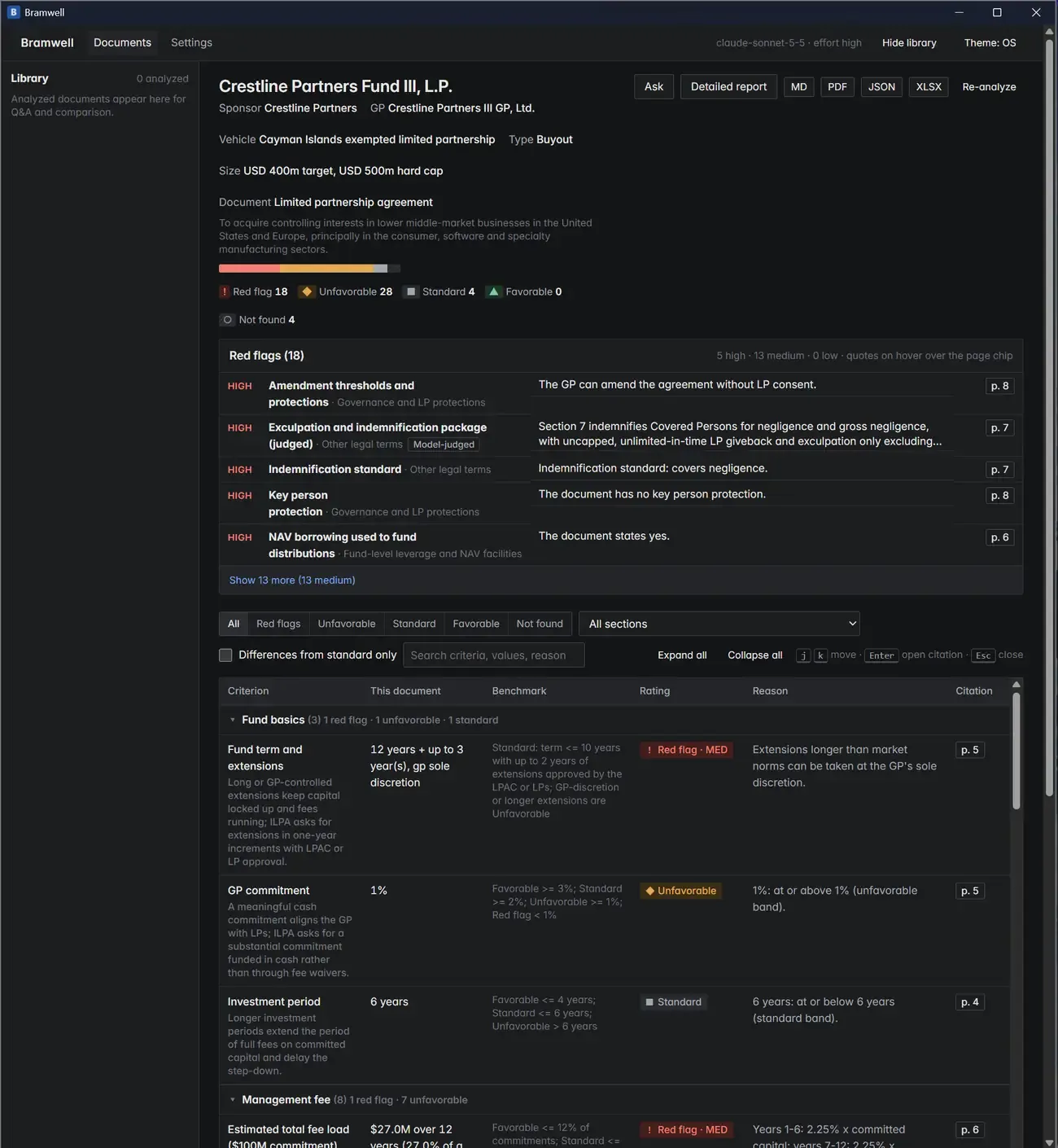
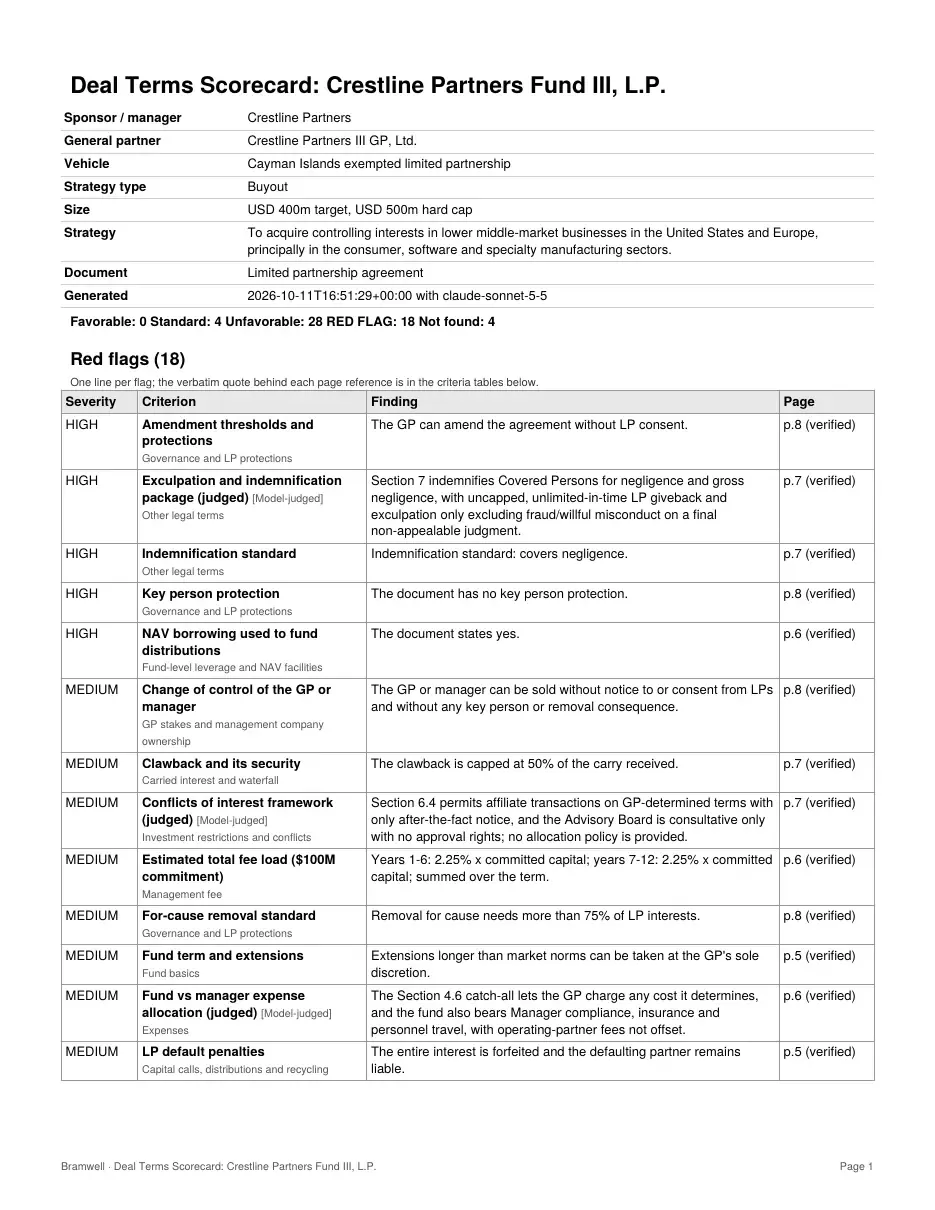
Every key term gets one of four ratings: red flag, unfavorable, standard or favorable. The counts and color bar show the overall picture at a glance and the most serious issues rise to the top. On the sample agreement that surfaced 18 red flags, including a GP who could amend the agreement without investor consent.
- 02
Every rating points at its clause
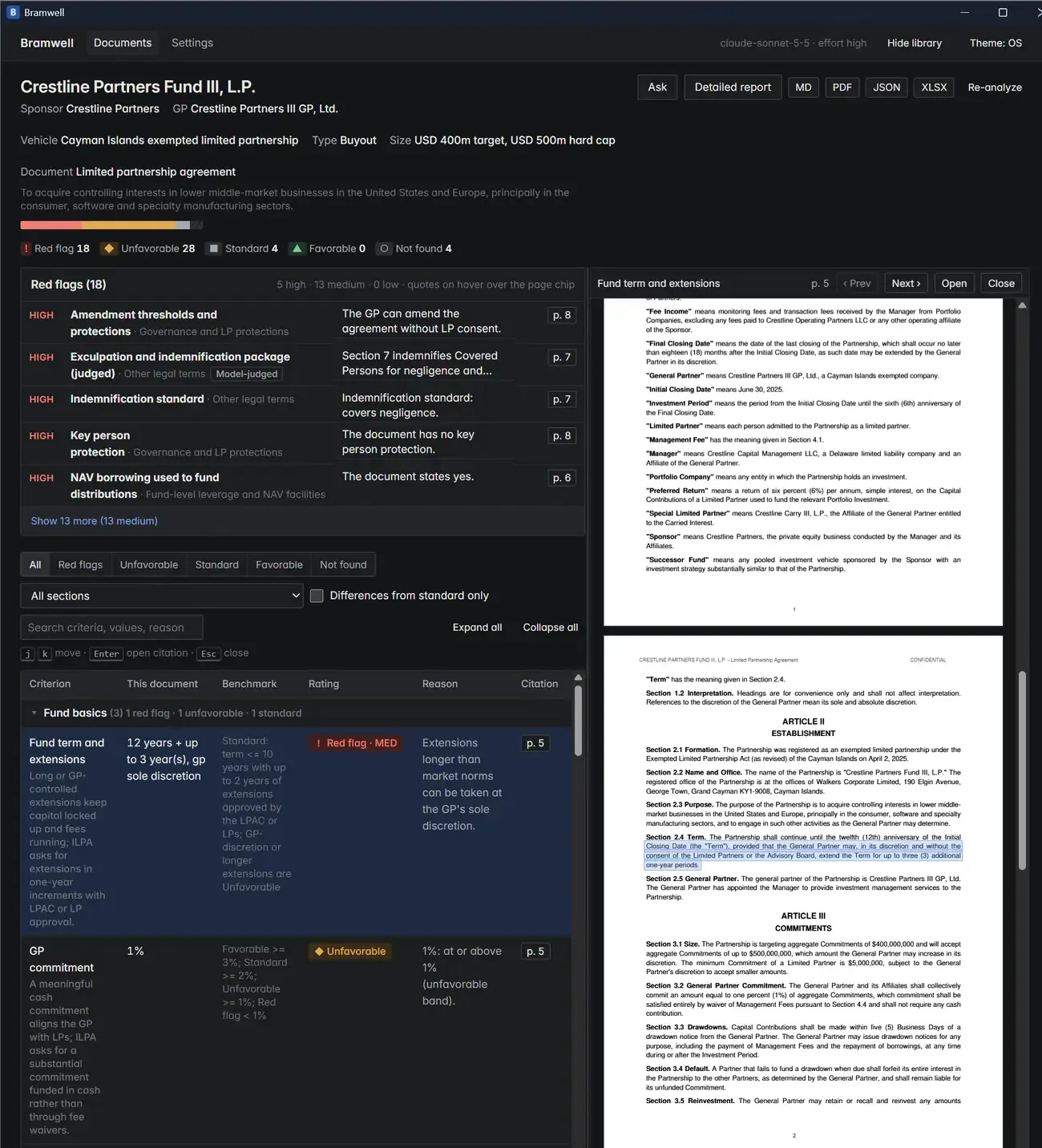
Click a page number and the original agreement opens beside the scorecard with the exact sentence highlighted. Each citation is checked against the real text before it is shown, so a reviewer can verify any finding in seconds rather than take it on faith.
- 03
Organized the way reviewers already think
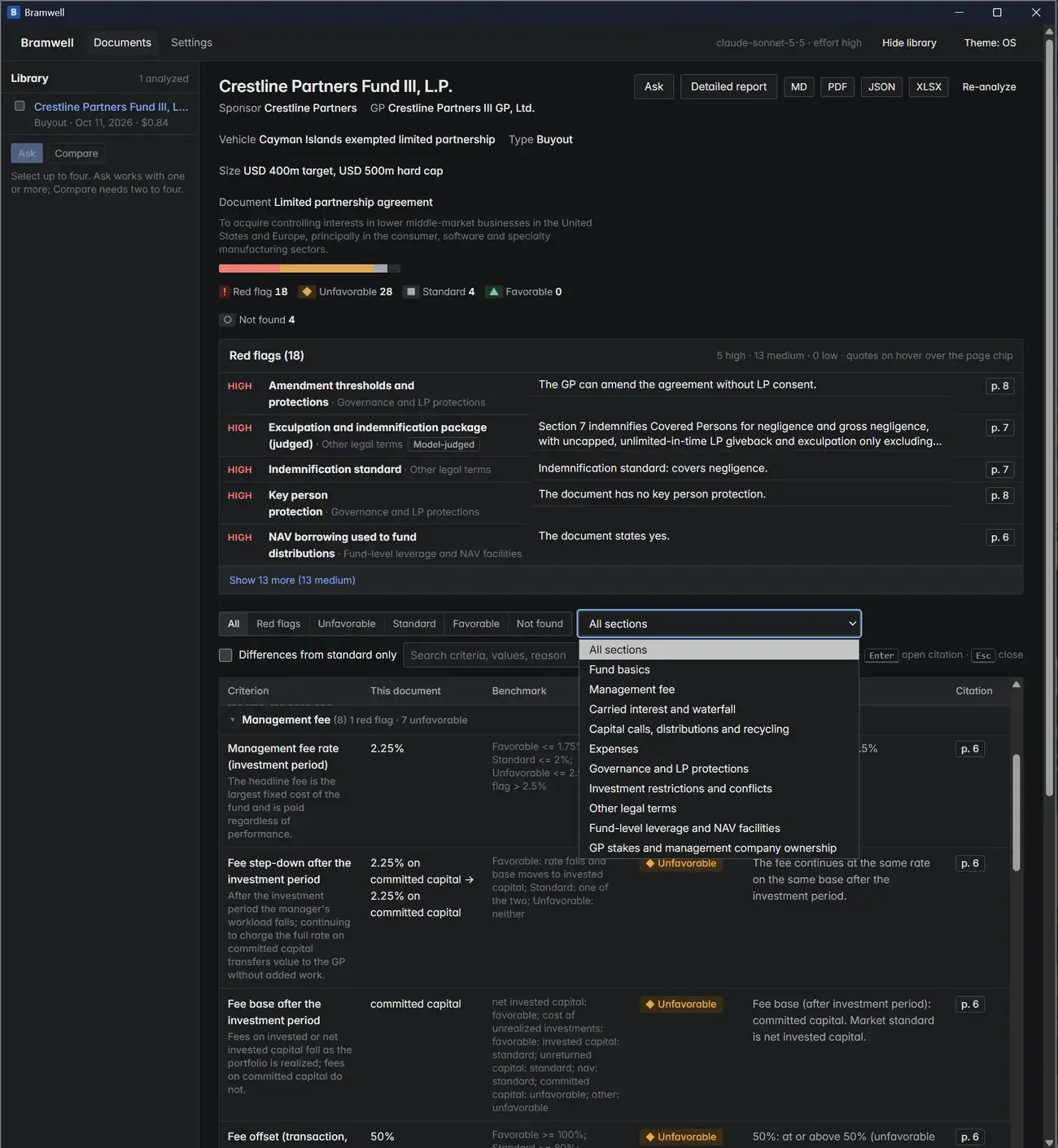
Findings are grouped into 11 sections, from fund basics and management fees through carried interest, expenses, governance and NAV facilities. Each row shows what the document says, the market benchmark, the rating and the reason, and the whole thing can be filtered down to what differs from standard.
- 04
Ask the document a question
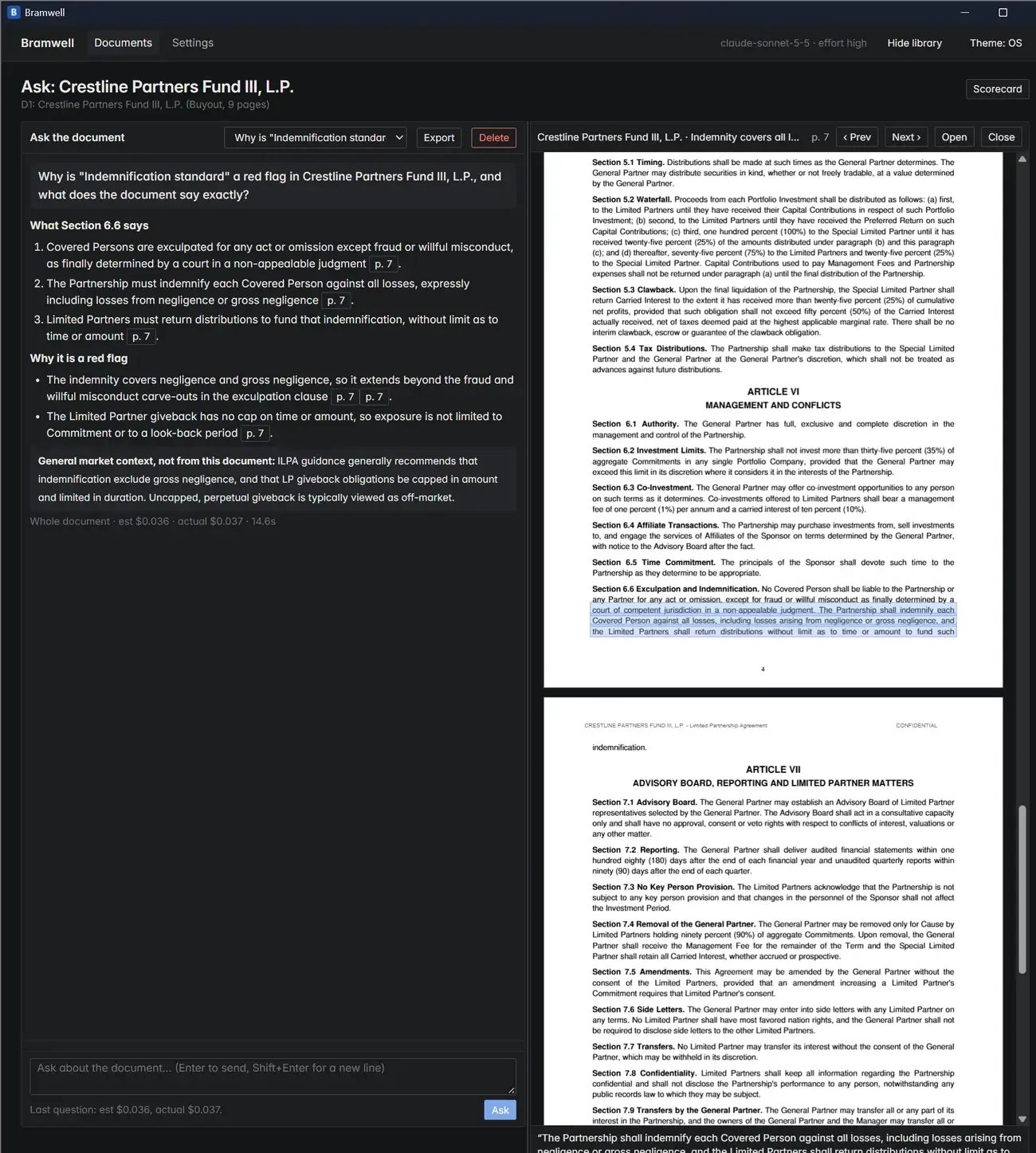
Reviewers can question the agreement in plain English, and Bramwell suggests starter questions built from its own findings, including points to negotiate with the GP. Answers cite the clauses they rely on, keep the document's own language separate from general market context, and calculate fee and waterfall math directly rather than letting the model estimate it.
- 05
Sensitive files never leave the machine
It installs as a one-click Windows desktop app. Documents and results are stored locally and encrypted, and document text goes only to the AI provider for analysis under the client's own account, which the app says up front. No terminal, no server, nothing of theirs sitting on mine.
- 06
A report you can hand to a partner
One click exports the full scorecard as a PDF, an Excel workbook with live formulas, Markdown or JSON, with every page reference marked as verified.
- 54Deal terms checked against market benchmarks
- $0.84AI cost to analyze the sample agreement
- 18Red flags found in the sample agreement
In use
Notes
Where it came from
This one was commissioned. A group reviewing fund documents and single-company SPVs described what they wanted in one sentence: upload an investment agreement, get back a list of predetermined criteria rated fair, unfair or standard, and have the red flags highlighted. Bramwell is that sentence built out, delivered and installed on their machines, and the first piece of work done under Slipstream Systems, the consulting business I started around it.
The part worth pointing at
The hard requirement was not the analysis. It was trust. A reviewer who has to re-read the whole agreement to check the tool’s work has gained nothing, so every rating had to point at the clause it came from, and every citation had to be verified against the real text before it was shown. The same principle runs through the Q&A: the document’s own language is kept apart from general market context, and anything with numbers in it, fees, waterfalls, is calculated rather than estimated.
The second requirement was confidentiality. These are documents nobody wants on a stranger’s server, so there is no server. It runs on the client’s own computer, stores everything locally and encrypted, and is explicit about the one place document text does go.
Where it stands
Delivered and in use. The next phase, if the client wants it, is comparing several funds side by side and extending the Q&A across a whole portfolio of agreements rather than one at a time.